
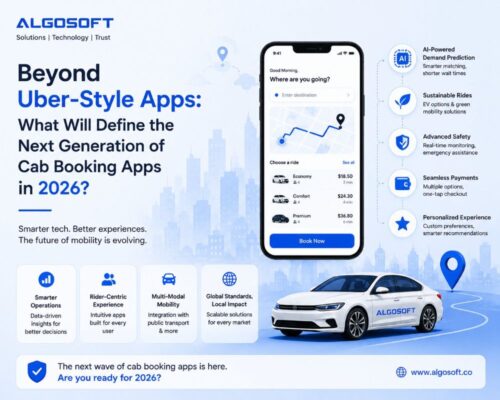
How Real-Time GPS and Route Optimization Improve Cab Booking
- Street: C-25, MiQB Building , Sector 58, Noida, Uttar Pradesh 201309
- City: Noida, Uttar Pradesh
- State: Uttarpradesh
- Country: India
- Zip/Postal Code: 201309
- Contact No: +917011969292
- Email ID: [email protected]
- Website: https://www.algosoft.co/cab-booking-app-development-company-india
- Listed: August 29, 2026 6:40 pm
- Expires: 29 days, 21 hours
Description
The way people book and experience rides has changed significantly with the growth of mobile technology. Modern cab booking applications are no longer limited to connecting passengers with available drivers. They now rely on location technology, route optimization, real-time tracking, digital payments, and data-driven systems to make urban transportation more convenient.
Among these technologies, GPS and route optimization play a particularly important role.
A well-designed cab booking platform can use real-time location information to identify nearby drivers, estimate pickup times, calculate routes, and provide passengers with greater visibility throughout their journey.
For businesses planning a modern mobility platform, working with a Cab Booking App Development Company India can help turn these capabilities into a reliable and scalable application.
Real-Time GPS Makes Driver Tracking Possible
GPS is one of the foundations of a modern cab booking application.
When a passenger requests a ride, the platform can use location data to identify available drivers within a relevant area.
The passenger can then receive information about the driver’s location and estimated arrival time.
This creates a more transparent experience than traditional taxi booking methods, where passengers may have little information about where their vehicle is located.
For drivers, GPS can also help identify the passenger’s pickup location and provide navigation assistance.
More Accurate Pickup Estimates
One of the biggest frustrations for passengers is uncertainty about when their ride will arrive.
Distance alone does not always provide an accurate estimate.
A vehicle traveling through a busy urban area may take considerably longer than one traveling the same distance on an open road.
Real-time location data combined with traffic information can provide better estimates.
The application can continuously update the estimated arrival time as the driver’s position and surrounding conditions change.
This helps passengers plan their time more effectively.
Route Optimization Reduces Unnecessary Delays
Finding a route is not simply about choosing the shortest distance.
A route that appears shorter on a map may take longer because of traffic congestion, road restrictions, construction, or other conditions.
Route optimization systems can evaluate available routes and identify options that may provide a more efficient journey.
Depending on the technology used, the application can consider factors such as distance, traffic conditions, road networks, and estimated travel time.
The result can be a smoother journey for both passengers and drivers.
Better Driver Efficiency
Route optimization is also valuable from the driver’s perspective.
Drivers spend a significant amount of time traveling between pickup locations and destinations.
More efficient navigation can help reduce unnecessary driving and improve the utilization of available vehicles.
For fleet operators, this can translate into better operational visibility and potentially improved resource management.
A platform can also use historical trip data to understand common routes and traffic patterns.
Improving the Passenger Experience
Passengers generally want three things from a cab booking application: convenience, predictability, and transparency.
Real-time GPS contributes to all three.
Users can see where their driver is, receive estimated arrival information, and follow the journey after the ride begins.
Route optimization can further improve the experience by helping the platform identify efficient routes.
These features can make the application feel more responsive than a basic booking system.
Dynamic Route Updates
Urban traffic can change quickly.
An accident, road closure, weather event, or sudden congestion can affect a journey after the ride has already started.
A modern application can respond to changing conditions by updating navigation information.
The driver can receive a revised route while the passenger continues to see relevant journey information.
This ability to adapt is particularly useful in large cities where traffic conditions can change within minutes.
Location Data Can Support Better Business Decisions
GPS information is not only useful during an individual ride.
Aggregated and appropriately managed location data can provide businesses with insights into transportation demand.
For example, operators may identify areas where ride requests frequently increase at particular times.
They can use these insights to understand demand patterns and improve driver allocation.
Businesses can also analyze trip durations, popular routes, pickup locations, and other operational metrics.
These insights can support better planning.
Safety and Visibility
Real-time tracking can also contribute to passenger safety.
When a trip is active, t
6 total views, 6 today
Listing ID: 3026a93277e57585

- Listed by: algosoftappstech
- Member Since: August 10, 2026
Other items listed by algosoftappstech
- India’s Quick Commerce Boom: What Businesses Need to Know Before Building a Delivery App
- How Android Apps Are Adapting to Foldables, Tablets and Connected Devices